

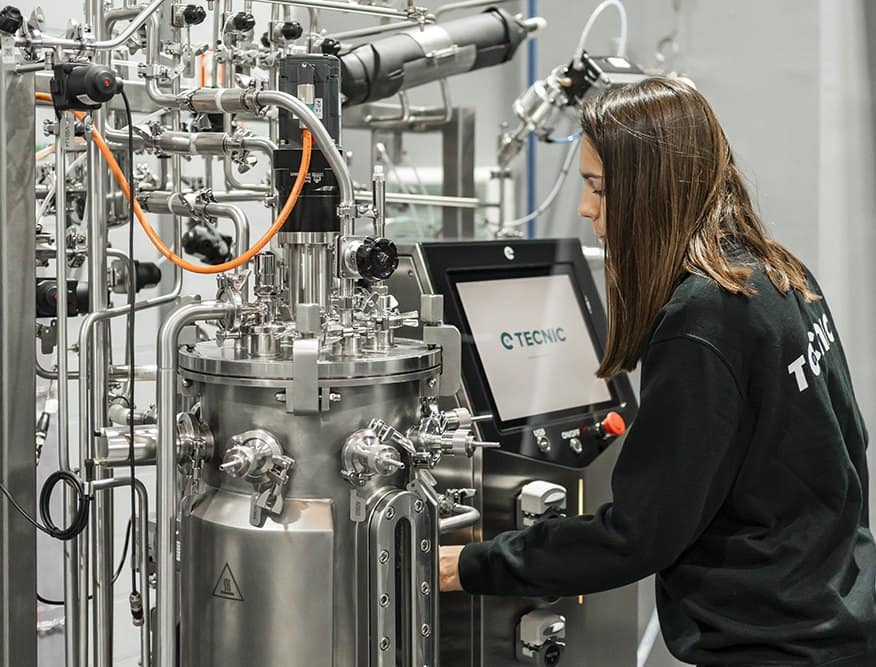
Empirical correlations provide a starting estimate, but only Computational Fluid Dynamics (CFD) can resolve the internal 3D spatial velocity, shear rate, and gas-holdup fields inside an industrial bioreactor. Physical sampling cannot measure turbulent energy dissipation at the impeller blade tip, yet this parameter dictates whether shear-sensitive mammalian cells survive or lyse during high-power agitation.
1. Multiphase Hydrodynamic Formulations
Accurate bioprocess CFD requires solving the Eulerian-Eulerian two-fluid model, where continuous broth and dispersed gas bubbles are treated as interpenetrating continua:
∂(αk ρk uk) / ∂t + ∇ · (αk ρk uk uk) = –αk ∇p + ∇ · τk + αk ρk g + Mik
Where αk is the phase volume fraction, and Mik represents interphase momentum exchange including drag (Grace or Ishii-Zuber models), turbulent lift, virtual mass, and turbulent dispersion forces.
2. Turbulent Shear Stress and Kolmogorov Microscales
Cell damage occurs when the smallest turbulent eddies (the Kolmogorov microscale, η) approach or become smaller than the cell diameter (dcell ∼ 15–25 μm for CHO cells):
η = (ν3 / ε)1/4
Where ν is kinematic viscosity (m2/s) and ε is the local turbulent dissipation rate (W/kg). Because local ε near impeller blade tips can exceed the average tank dissipation rate (ε̄) by 15 to 40 times, CFD enables engineers to optimize blade camber, rounded trailing edges, and lower rotational speeds to maintain η > dcell.
💻 Explore CFD Simulation Services
BioFlo delivers full 3D steady-state (MRF) and transient (sliding mesh) CFD simulations to optimize gas holdup, power draw, and scale-up reliability.
3. Multiple Reference Frame (MRF) vs. Sliding Mesh (SMM)
Industrial bioprocess CFD relies on two computational approaches for modeling impeller rotation:
- Multiple Reference Frame (MRF): A steady-state approximation that freezes impeller orientation while adding Coriolis and centrifugal acceleration terms to the momentum equations in the rotating zone. Ideal for rapid screening of power numbers (Np) and blend times.
- Sliding Mesh Method (SMM): A fully transient formulation where the impeller grid physically rotates relative to the stationary tank baffles at every time step. SMM accurately resolves periodic vortex shedding, torque oscillations, and local gas pocket formation behind Rushton blades.
Need Advanced Bioreactor CFD Modeling?
BioFlo provides complete mesh independence studies, validation against laser Doppler anemometry (LDA) benchmarks, and turnkey multiphase simulation reports for pharmaceutical clients.
CFD Bioreactor Simulation: Multiphase Bubble Dispersion, Turbulent Kinetic Energy, and Shear
Computational Fluid Dynamics (CFD bioreactor simulation) models coupled Reynolds-Averaged Navier-Stokes (RANS) equations with Eulerian-Eulerian two-phase bubble dispersion to quantify spatial dead zones, local energy dissipation rates (\( \varepsilon \)), and shear stress distributions across industrial impellers.