

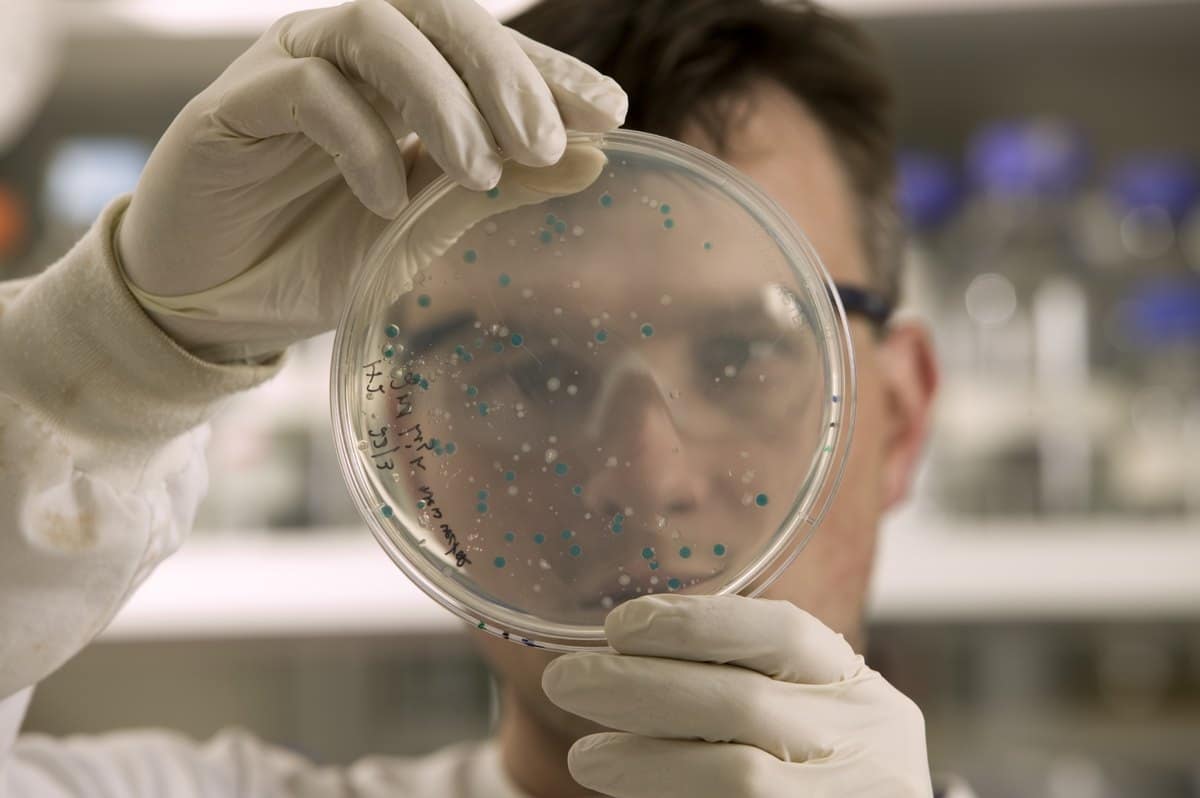
Manual quantification of Colony Forming Units (CFU) on agar plates is one of the most tedious, error-prone tasks in biotechnology, microbiology, and quality control. Studies show inter-operator counting variability of 15% to 32% on plates with clustered colonies, spreading morphologies, or agar meniscus reflections. PetriPlate AI applies advanced browser-based computer vision to automate this workflow with sub-second accuracy.
1. The Algorithmic Pipeline
Automating colony detection requires a multi-stage image processing pipeline that isolates the agar petri dish and suppresses background reflections:
- Circular ROI Extraction: The petri dish outer rim is identified using a modified circular Hough transform, masking out benchtop clutter, petri edges, and hand shadows.
- Adaptive Color Thresholding & Contrast CLAHE: Contrast Limited Adaptive Histogram Equalization normalizes uneven illumination caused by room lighting or flash reflections.
- Euclidean Distance Transform & Watershed Segmentation: Clustered colonies that touch or overlap are separated by computing distance maps from colony edges to local centroids.
- Size and Circularity Filtering: Artifacts such as air bubbles, dust specks, and agar tears are filtered out by rejecting contours with low circularity (4π × Area / Perimeter2 < 0.65).
🔬 Try PetriPlate AI Live in Your Browser
Upload an agar plate photo from your phone or camera to count colonies and calculate exact CFU/mL instantaneously.
2. Serial Dilution Mathematics and Standard Errors
Once counts are obtained, calculating microbial concentration requires weighting across dilution series:
CFU / mL = (Σ C) / [ (n1 + 0.1 × n2) × d × Vplated ]
Where ΣC is the sum of colonies across countable plates (30–300 colonies), n1 and n2 are the number of replicates at consecutive dilution steps, d is the primary dilution factor, and Vplated is the volume inoculated (mL). PetriPlate AI pairs with our online scientific suite to output regulatory-compliant laboratory reports.
Automate High-Throughput Bio-Assays
BioFlo builds custom high-content image analysis pipelines, robotics integrations, and validated computer vision algorithms for pharmaceutical microbiology and QA labs.
Automated Colony Counter Online: PetriPlate AI Computer Vision and CFU Sizing
PetriPlate AI is an online automated colony counter tool that replaces manual microbiology tally counting with deep learning and computer vision (CV). Utilizing automated circular Hough transforms and watershed segmentation, it instantly segments clustered bacterial colonies, calculates CFU/mL across serial dilutions, and measures inhibition halos in seconds.