

Scaling up a microbial or mammalian cell culture from laboratory bench-scale (1L–5L) to commercial manufacturing (1,000L–25,000L+) is one of the most failure-prone transitions in bioprocess commercialization. Physics dictates that geometric similarity does not conserve physical phenomena: holding power per unit volume constant drastically increases impeller tip speed, while maintaining constant tip speed results in severe oxygen mass-transfer starvation.
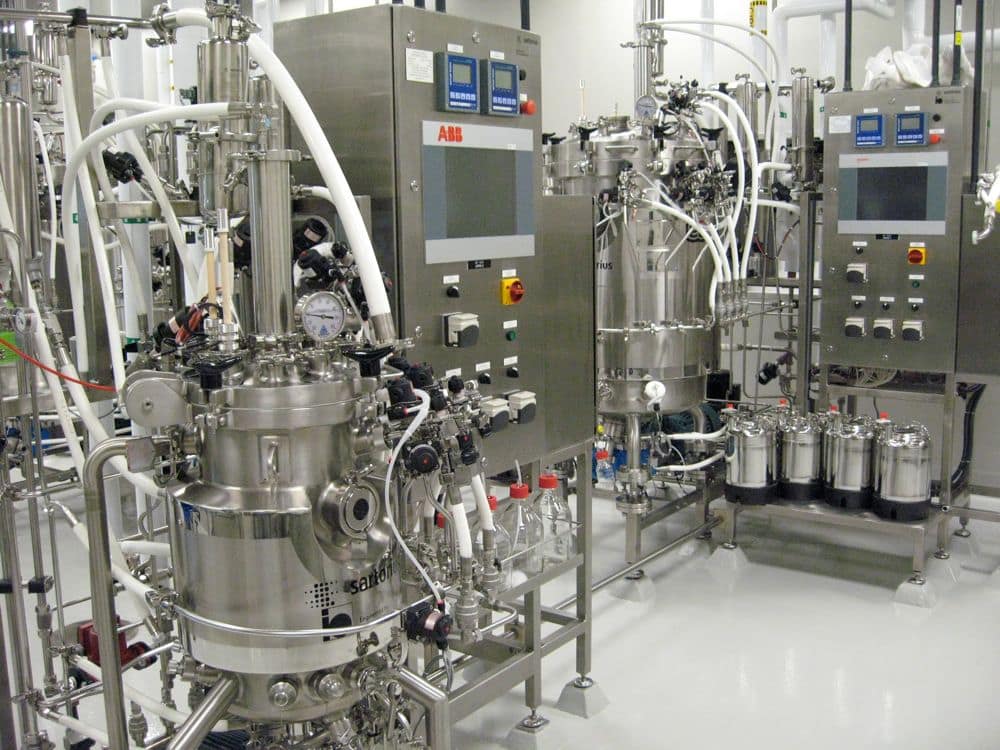
1. The Fundamental Scale-Up Paradox
When increasing vessel volume by a factor of 1,000, geometrical dimensions scale with the cube root (T2/T1 = λ1/3 = 10). The fundamental conflict arises because three primary scaling criteria are mathematically mutually exclusive:
| Scaling Criterion | Equation / Parameter | Impact at Large Scale (25,000L) | Risk Profile |
|---|---|---|---|
| Constant Power per Volume (P/V) | P/V ∝ N3Di2 = const | Tip speed (vtip) increases by ∼2.15× | Cell shear damage, impeller erosion |
| Constant Tip Speed (vtip) | vtip = πNDi = const | P/V drops by ∼4.64×, kLa drops by ∼65% | Severe oxygen starvation (DO < 10%) |
| Constant Reynolds Number (Re) | Re = ρNDi2/μ = const | Agitation speed drops exponentially (N2 = N1/100) | Total mixing loss, stagnant stratification |
⚡ Interactive BioFlo Companion Calculator
Model your vessel geometry, impeller power numbers, and dimensionless numbers instantaneously using our online Biocalc suite.
2. Mixing Time (θ95) and Nutrient Gradients
<
p class=”wp-block-paragraph”>At bench scale (3L), 95% homogeneity is reached within 2 to 5 seconds. In a 20,000L production vessel, mixing time (θ95) typically extends to 60 to 120 seconds:
θ95 = 5.2 × [ (V / (P/ρ))1/3 × (T / Di)2 ] × f(impeller)
This prolonged mixing time creates localized micro-environments where cells near the nutrient feed point experience hyper-osmotic glucose shocks (>50 g/L), while cells near the liquid surface experience substrate starvation (<0.05 g/L). This metabolic cycling triggers overflow metabolism, acetate accumulation, and reduced titer.
3. Modern Industrial Scale-Up Strategy
- Hybrid Impeller Staging: Replace traditional dual-Rushton configurations with a bottom Rushton turbine for gas dispersion coupled with dual upper wide-blade hydrofoil impellers (e.g., Lightnin A315 or pitched blade) for strong top-to-bottom axial circulation.
- Variable Pressure Operation: Increase vessel head pressure to 0.5–1.5 bar gauge at commercial scale to boost the oxygen equilibrium driving force (C*) by 50–100%, without increasing agitation shear.
- Pre-Scale CFD Validation: Simulate Eulerian-Eulerian multiphase flow to pinpoint stagnant zones and shear hotspots before cutting steel.
Need Custom Bioreactor Scale-Up Engineering?
BioFlo provides hydrodynamic scaling audits, impeller retrofitting calculations, and full digital twin multiphase CFD modeling for pharmaceutical, cellular agriculture, and industrial fermentation clients.
Bioreactor Skids: Modular Architecture, P&ID Manifolds, and Pilot-to-Commercial Sizing
Bioreactor skids are self-contained, automated process platforms engineered on a structural stainless-steel frame that house the culture vessel alongside all utility, gas blending, thermal control, and sterile boundary transfer subsystems. In biopharmaceutical manufacturing, modular bioreactor skids (ranging from 50L pilot systems to 2,000L – 20,000L commercial production skids) minimize facility footprint and accelerate tech transfer.
| Skid Subsystem | Core Hardware Components | Key Engineering Function |
|---|---|---|
| Gas Sparging Train | Thermal mass flow controllers (MFCs), 0.2 μm sterile PTFE filters, check valves | Precise mass flow blending of Air, O2, N2, and CO2 to microsparger and macrosparger |
| Thermal Control Unit (TCU) | Dimple/half-pipe vessel jacket, plate heat exchanger, modulating steam/glycol valves | PID temperature regulation (±0.1°C) and automated SIP cycle heating (≥121.1°C) |
| Fluid Addition Manifold | Watson-Marlow peristaltic pumps, pinch valves, aseptic diaphragm valves | Sterile automated dosing of base, antifoam, feeds, and glucose concentrate |
| Off-Gas & Exhaust Condenser | Chilled exhaust condenser (glycol 4°C), heated 0.2 μm vent filter jacket | Prevents evaporative volume loss and eliminates vent filter wetting/overpressure |
| Automation & Instrumentation | DeltaV / Siemens PCS7 PLC, optical DO/pH sensors, load cells (weight ±0.05%) | Real-time automated recipe execution, closed-loop DO/pH cascade, 21 CFR Part 11 audit trail |
🛠️ Interactive Engineering Tool & Validated Model
BioFlo Computational Studio • 100% Open Access
Run Bioreactor Scale-Up Hydrodynamics in BioFlo Workbench
Calculate impeller tip speed (v_tip), volumetric power input (P/V), Reynolds number (Re), and blend time across benchtop, pilot, and 25,000L production scales. Compare constant P/V vs. constant tip speed in real time.